
Recommended configuration
Match equipment, routines, operators and contingency units to the event job, venue, duration and logistics.
ROBOT RENTAL
GUMA Robots coordinates available humanoid and quadruped platforms for commercial and evaluation projects. Availability and supported routines depend on date, location, product edition, software release and rehearsal. Each confirmed function must appear in the written event scope.
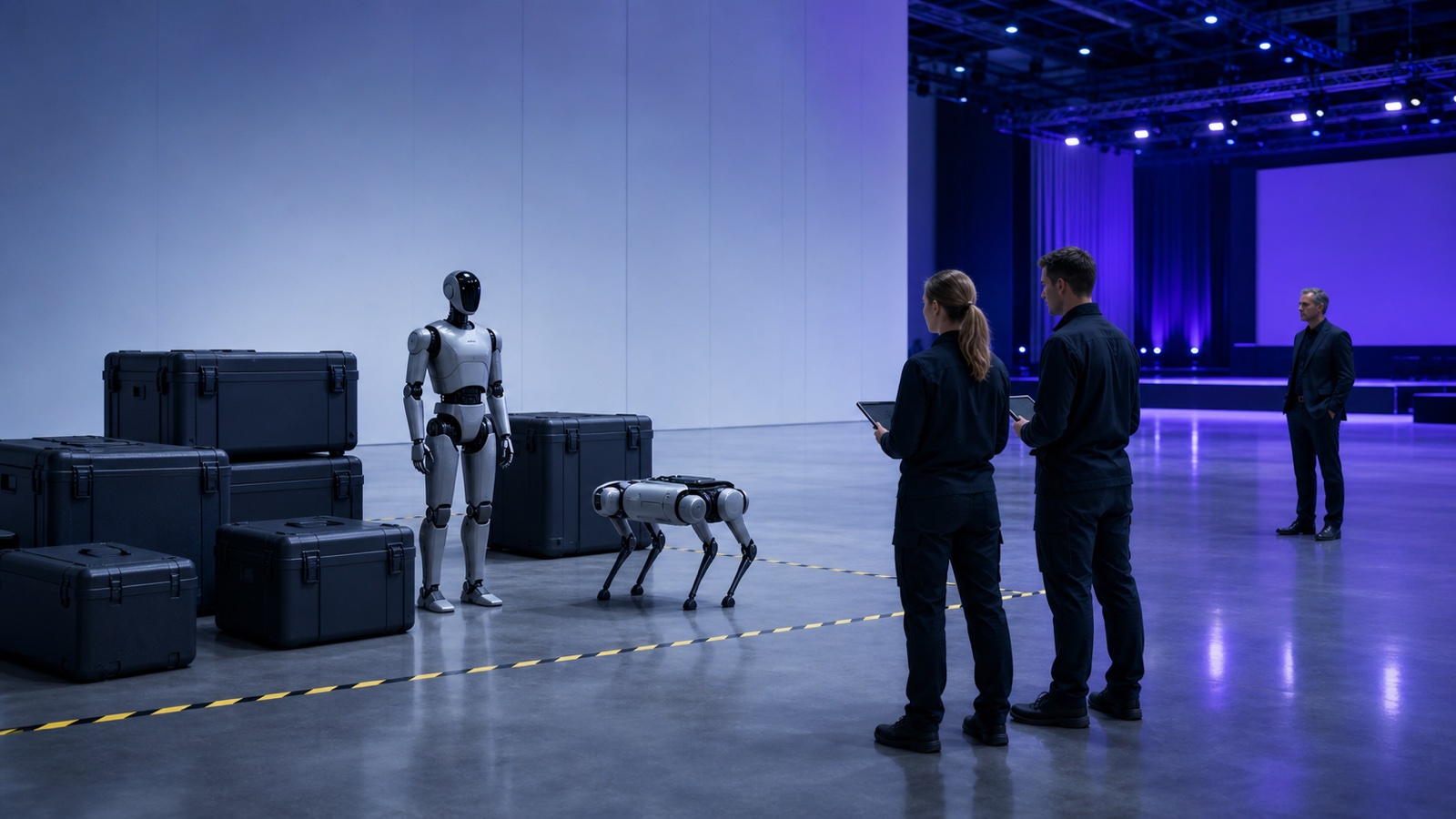
Rent humanoid and quadruped robots with equipment planning, content preparation, logistics, rehearsal, operator coverage and safety controls for events, exhibitions and pilot projects.
Confirm these items before quotation and scheduling; each project requires a tailored scope.
Match equipment, routines, operators and contingency units to the event job, venue, duration and logistics.
Date, city, floor plan, loading access, audience distance, power, network, run-of-show and approvals.
Rental list, logistics and rehearsal plan, on-site operation, safety boundary, strike plan and fallback.
Fleet availability, city and freight, routine customization, venue approval, rehearsal count and event hours.
These existing field and system materials illustrate crowds, sites, programs, maps and operating variables. They do not claim a customer outcome or replace exact-edition testing.


Rental is best for a defined objective and a limited period with operator support: greetings, fixed-point presentations, choreographed performance, brand interaction, filming or a structured pilot.
A long-running autonomous workflow, complex manipulation or deep enterprise integration usually requires a paid validation phase before a purchase or custom system project.
The outcome depends on scripts, music, motion, presentation copy, brand assets and stage direction. A stock routine is not a custom show; new choreography and multi-robot sequences require additional production and testing.
Approve content remotely before load-in, then perform equipment checks, blocking, safety-zone review and a full rehearsal on site. Multi-robot work also requires verified spacing, synchronization and emergency-stop control.
Transport, loading, charging, wireless conditions and operator access affect performance. The scope should identify staffing, working hours, charging location, crowd control, equipment supervision and overtime rules.
Operators may pause high-risk movement when floors are wet, slopes are unsuitable, crowds breach the boundary, weather changes or radio interference is detected. Safety takes priority over completing the programmed segment.
After the engagement, record completed tasks, operator interventions, device events and audience feedback. A move to permanent operation needs a new capacity, staffing, software and maintenance assessment.
Engagement or media figures should only become case-study results when the client authorizes publication and the measurement method is documented.
| Format | Best fit | Primary scope | Main risk |
|---|---|---|---|
| Single event | Launch, opening or brand activation | Robot, operator, rehearsal and removal | Schedule, venue or program change |
| Multi-day exhibition | Booth, mall or venue trial | Daily checks, charging and content rotation | Duty cycle, supervision and crowd flow |
| Validation project | Pre-purchase test or workflow pilot | Test plan, logs and review | Weak metrics or unrepresentative site |
A real selection decision must combine the job list, field conditions, exact-edition manufacturer documentation, a representative test and a written quotation. General guidance on this page does not replace final configuration, test records or acceptance documents.
Fact-checking note: capability, pricing and lead-time statements are conditional planning guidance, not guarantees for a site, outcome or return. Final results depend on the model, options, software release, site, network, operator readiness and signed scope. Confirm through site discovery, representative tests, a written quotation and current manufacturer documentation.
Date, city, hours, model, quantity, content or motion work, operators, freight, rehearsal and risk all affect price. An indicative range is not a confirmed quotation until these inputs are defined.
They can be assessed. Existing routines and copy updates are usually faster; new motion, multi-robot synchronization, knowledge content or system connections need production and testing, and are not supported by every model.
Typical needs include a safe load-in route, level operating area, charging power, storage, network information, a site contact and crowd management. The final list follows the site review.
Yes, but product configuration, any rental credit and lead time require a new commercial agreement. Pilot logs should be converted into purchase acceptance criteria.
Share the city, date, operating window, audience, required routines and venue information. We will review availability, risk and production effort.