
Recommended configuration
Choose an industrial quadruped, sensor payload, communications, edge compute, backend and human review from the defect and terrain.
INDUSTRIAL INSPECTION SOLUTION
Quadrupeds can address steps, debris and constrained routes that challenge wheeled platforms. Protection, hazardous-area approval, temperature and payload depend on the final product and integration. Equipment without the required certification must not be represented as explosion-protected or suitable for a regulated zone.
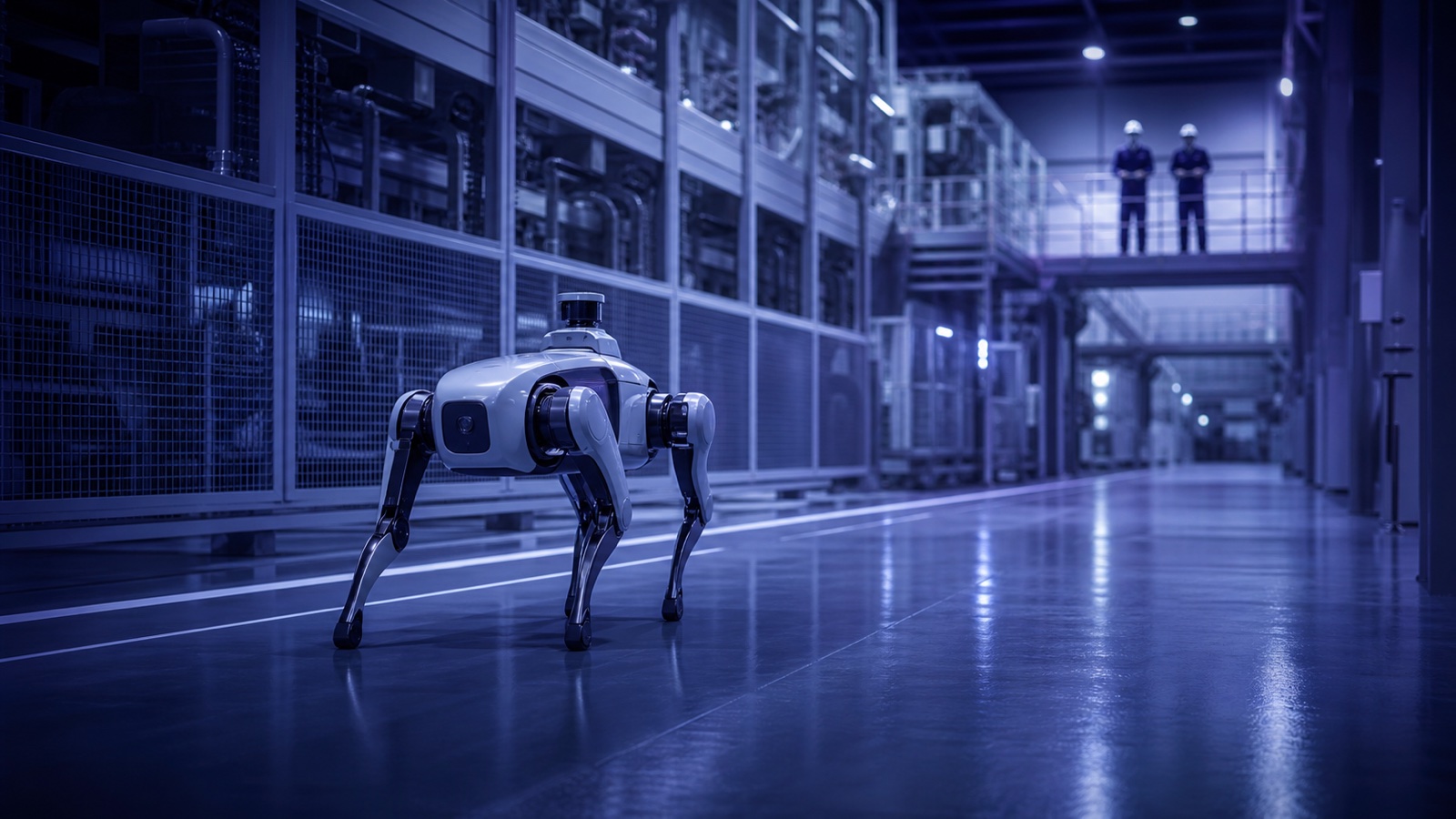
Industrial inspection robot selection and pilot guide comparing Unitree B2 and As2 weight, protection, payload, runtime and development access, plus sensing, routes, alerts, acceptance and operations.
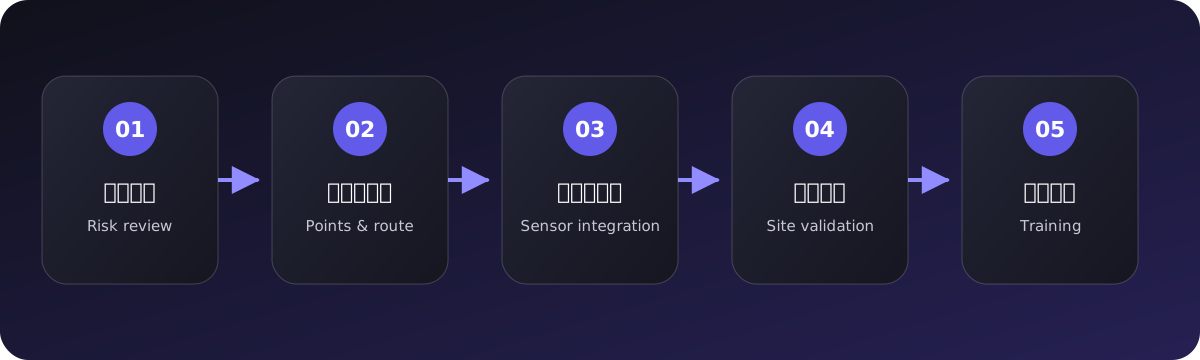
Confirm these items before quotation and scheduling; each project requires a tailored scope.
Choose an industrial quadruped, sensor payload, communications, edge compute, backend and human review from the defect and terrain.
Defect definition, routes, conditions, hazards, coverage, data systems, access rules and safety owner.
Site assessment, payload/interface design, PoC route, data and alert workflow, test report and operating boundary.
Site access, payload integration, communications and localization, hazardous-area requirements, APIs, seasons and test windows.
These existing field and system materials illustrate crowds, sites, programs, maps and operating variables. They do not claim a customer outcome or replace exact-edition testing.


Document slopes, steps, drops, water, dust, temperature, glare, narrow points, network gaps and vehicle interaction. A flat demonstration route materially understates deployment risk.
Routes need task points, observation pose, fallback point, charger, takeover and recovery access. Existing permits and hazardous-area procedures still apply.
Unitree currently lists B2 at about 60kg with battery and IP67, with standing payload at least 120kg and continuous walking payload above 40kg. Published endurance is over 5 hours unloaded and over 4 hours with a 20kg load. The published speed above 6m/s requires a special configuration and is safety-limited in practice.
As2 is about 18kg with battery; PRO and EDU are IP54. Across AIR/PRO/EDU, listed standing payload is about 45/55/65kg and walking payload about 10/13/15kg. PRO and EDU list about 4 hours unloaded. AIR and PRO do not provide user development access while EDU does, so SDK, payload and task-platform integration require the exact edition.
Visible, thermal, gas, acoustic, discharge and gauge-reading tasks have different range, angle, accuracy and calibration needs. Payload also affects runtime, center of gravity and access.
Define the anomaly, tolerated false negative and false positive, review method and data format before choosing sensors. “AI detection” is not a defect specification.
Models and thresholds can miss or over-report events. High-consequence alerts should retain source imagery, time, location, sensor value and model release for review by qualified staff.
On loss of communication, localization error, low battery or sensor fault, the robot should stop, return to a safe state or notify staff rather than continuing with unknown status.
Run the pilot across representative shifts, weather, lighting and production states. Measure route completion, task-point coverage, intervention, data completeness, false alerts, missed known events and downtime.
Long-term operation includes batteries, feet, cables, calibration, cleaning, spares, software release and staff training. Value should be tied to verified tasks and risk reduction, not a generic labor-saving claim.
| Dimension | Example test | Evidence | Failure response |
|---|---|---|---|
| Mobility | Representative route, steps and constraints | Track, video and intervention log | Reroute, limit or stop |
| Sensing | Known abnormal and normal samples | Raw data, result and release | Tune, resample or change payload |
| Communication | Coverage gap, handover and takeover | Network log and recovery time | Local degraded mode or safe return |
| Operations | Repeated shifts, charging and inspection | Task, incident and maintenance log | Change schedule, spares or scope |
A real selection decision must combine the job list, field conditions, exact-edition manufacturer documentation, a representative test and a written quotation. General guidance on this page does not replace final configuration, test records or acceptance documents.
Fact-checking note: capability, pricing and lead-time statements are conditional planning guidance, not guarantees for a site, outcome or return. Final results depend on the model, options, software release, site, network, operator readiness and signed scope. Confirm through site discovery, representative tests, a written quotation and current manufacturer documentation.
They are often considered where steps, debris, slopes or constrained routes limit wheeled systems. Suitability still depends on terrain, environment, protection, payload and connectivity and requires a site trial.
Only equipment and payloads with the applicable approval and operating conditions may enter the specified zone. Adding an enclosure or sensor does not automatically make a standard robot explosion-protected.
Use representative normal and abnormal samples, define false-negative and false-positive handling, and record model, threshold, range, lighting and sensor configuration.
It depends on routes, operating variation, available defects, production access and acceptance depth. The pilot should cover representative conditions rather than one ideal period; timing follows discovery.
Share site drawings, task points, environment, target anomalies, connectivity and system interfaces. We will prepare a payload and pilot-validation checklist.