
ROBOT MODEL COMPARISON
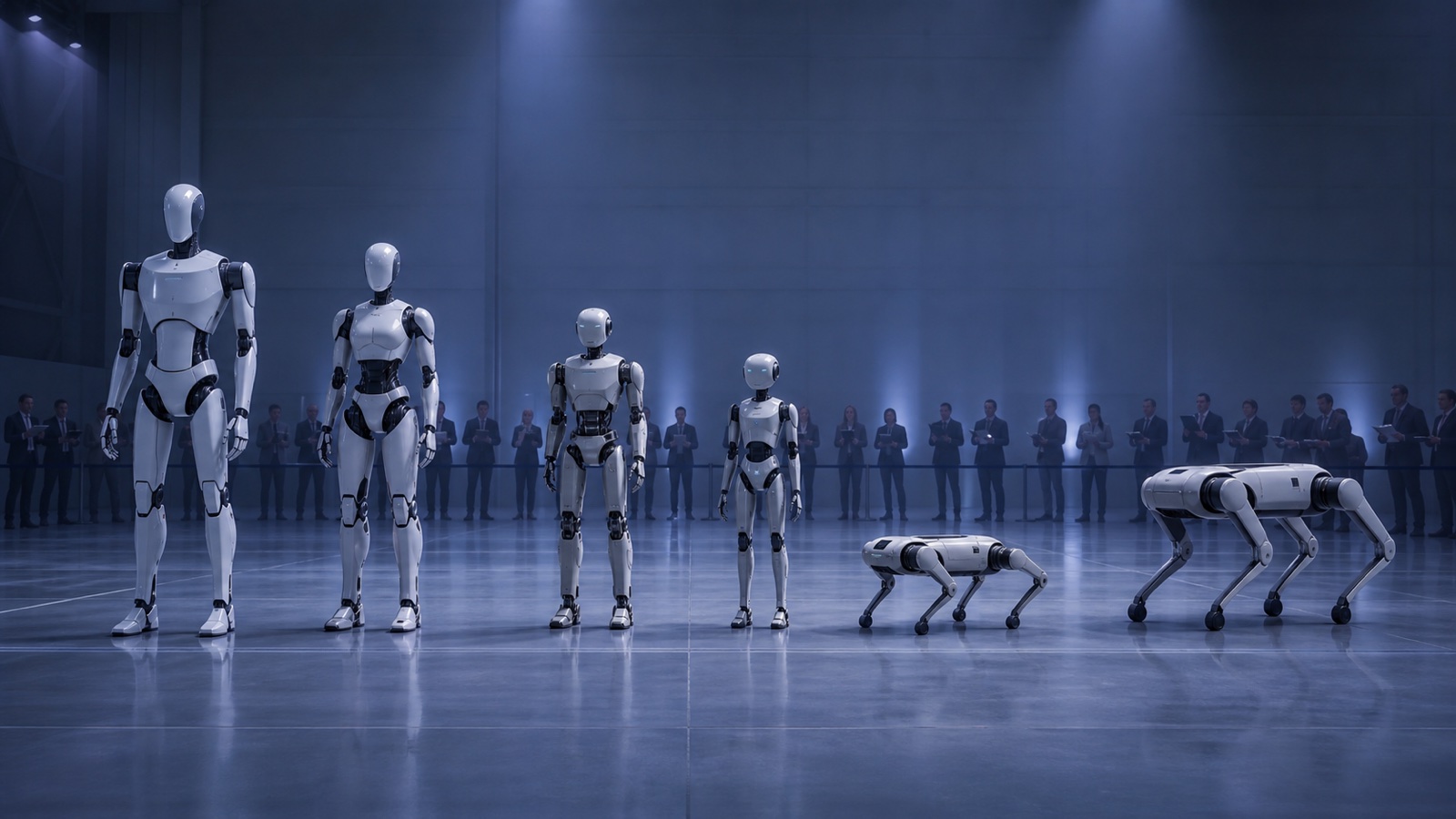
G1 vs H1 vs H2 vs R1 vs Go2 vs B2: choose by task
These six families serve different tasks and may include materially different editions and options. This is a positioning framework, not a live specification, price, regional license or availability statement. Validate the exact order configuration before purchase.
Decision points
Compare Unitree G1, H1, H2, R1, Go2 and B2 by form, logistics, interface access, payload, site needs and total cost for education, research, display and industrial projects.
Put field conditions back into the proposal
These existing field and system materials illustrate crowds, sites, programs, maps and operating variables. They do not claim a customer outcome or replace exact-edition testing.


Implementation and decision framework
Filter by physical deployment first
Confirm doors, lifts, cases, stage, floor loading, charging and the protected operating zone. Lighter systems are easier to handle in classrooms and events; full-size systems normally require stricter supervision and logistics.
Dynamic movement should not be the only filter. Fixed presentation, coursework, whole-body control and payload research call for different hardware and access.
- Standing and packed dimensions
- Weight, handling and freight
- Floor, clearance and operating zone
- Runtime, charging and battery exchange
Verify access on the exact edition
G1, H1, H2, R1, Go2 and B2 editions may differ in joints or legs, end effectors, sensors, compute, SDK and low-level control.
Ask for standard, optional, engineering and unsupported items, then complete a representative experiment on a configuration equivalent to the order. A video of another edition is weak evidence.
- Joints, legs and end effectors
- Sensors and onboard compute
- Control interface and simulation
- License and regional availability
Compare task groups, not one headline figure
Education needs documentation, simulation, curriculum and safety; events need stable routines and logistics; research needs control, data and reproduction; service interaction needs dialogue, content, mobility and handoff.
Strength on one task does not imply the lowest total cost on another. Include implementation, people and maintenance in the comparison.
Finish with equivalent evidence
Test candidates on the same task, site and metric, recording success, failure, intervention, software release and options.
Attach the result to configuration and acceptance documents and verify lead time, training, spares, warranty, updates and safety ownership. Unvalidated roadmap functions stay outside acceptance.
| Family | Typical positioning | Verify before purchase | Primary trade-off |
|---|---|---|---|
| R1 | Lightweight humanoid experience, teaching and basic interaction | Edition access, motion, sensors and compute | Portability versus research depth |
| G1 | Humanoid education, research, motion and interaction | Edition, hands, control rights and toolchain | Capability breadth versus configuration complexity |
| H1 | Full-size locomotion and performance research | Site, safety, logistics, control and load boundary | Performance versus deployment cost |
| H2 | New-generation full-size humanoid evaluation | Current release, maturity, delivery and support | Frontier capability versus release change |
| Go2 | Education, algorithms, interactive display and light quadruped development | Edition, SDK, sensors, runtime and regional functions | Portability and cost versus payload and industrial tolerance |
| B2 | Industrial inspection, payload and complex-site quadruped integration | Payload, sensing, communications, protection, site test and support | Industrial capability versus implementation and safety cost |
Project decision evidence
A real selection decision must combine the job list, field conditions, exact-edition manufacturer documentation, a representative test and a written quotation. General guidance on this page does not replace final configuration, test records or acceptance documents.
Limitations and operating boundaries
- Specifications, price, software and orderable editions change; this article is not a live commitment.
- Family positioning never replaces the exact configuration, interface, license and test.
- Motion footage does not prove sustained operation, payload, navigation or business workflow.
- Humanoid platforms create fall, collision and pinch hazards and need a boundary, trained supervision and stop control.
Fact-checking note: capability, pricing and lead-time statements are conditional planning guidance, not guarantees for a site, outcome or return. Final results depend on the model, options, software release, site, network, operator readiness and signed scope. Confirm through site discovery, representative tests, a written quotation and current manufacturer documentation.
Frequently asked questions
Is R1 or G1 better for teaching?
It depends on the course. R1 may suit lightweight exposure and introductory programming; an appropriate G1 edition may suit broader control, sensing or research. Decide from access, documentation and a representative lab.
When should a buyer choose Go2 or assess B2?
Go2 is usually a lighter education, algorithm and interaction platform. B2 is evaluated for payload, inspection and complex industrial sites and requires site-specific sensing, communications, protection, safety and support checks.
Is a humanoid automatically better than a quadruped for enterprise work?
No. Form should follow the job, terrain, interaction and safety envelope. Full-size humanoids create higher site and supervision demands, while quadrupeds do not prove an untested workflow by shape alone.
How can a buyer verify development access?
Review the exact SKU's SDK, control rights, sensor data, simulation, examples and license, then run a representative interface test before contracting.
Continue reading
Test humanoid candidates against the same job
Share the use case, logistics and site limits, development target and budget frame. We can structure configuration and test questions for G1, H1, H2, R1, Go2 and B2.